Governance Class 11
A BRIEF OVERVIEW OF THE PREVIOUS CLASS (01:00 PM)
ROLE OF CIVIL SERVICES IN A DEMOCRACY (01:05 PM)
- Functions of civil servants
- a) In a parliamentary democracy, the political executive is responsible for policy formulation, whereas the bureaucracy is responsible for its implementation. The cabinet is the highest policy-making body but the Cabinet consists of professional politicians who do not have any skills or Knowledge related to administration.
- Policy making is a highly technical activity that requires specialized skills and knowledge.
- b) Civil servants are professional administrators who possess those skills and Knowledge. They are expected to provide unbiased, meritorious, impartial, and rational suggestions for political executives in policy formulation. They are part of the "Permanent Executive" whereas Ministers are part of the temporary executive.
- Mostly, the ministers are guided by Short-term Populism in policy formulation which can have adverse consequences for the country in the long term.
- Civil servants must take into consideration long-term consequences and provide rational suggestions to the political executive in policy formulation.
- Once policy decisions are made by the cabinet, civil servants are expected to implement policies strictly according to rules and regulations.
- c) Civil servants are also expected to maximize revenue for the government by eliminating the scope for corruption and leakages.
- d) Maintenace of law and order is one of the most important functions performed by civil services. It is necessary to ensure rapid economic growth. Political stability, policy certainty, and continuity are pre-requisites for the success of capitalist societies
- e) Civil servants are expected to bring about the socio-economic transformation of the society.
- Social transformation in the form of empowerment of socially backward sections of society including scheduled castes, Scheduled tribes, OBCs, Minorities, and women.
- Economic transformation includes maximizing GDP growth, increasing per capita income and standard of life, ensuring job-led growth, and enhancing productive capacities of economic systems by improving infrastructure and industrialization.
- f) Civil servants are also responsible for the implementation of developmental and welfare schemes of central and state governments. More than 580 schemes are implemented and it is the civil servants who must ensure that the benefits would reach the targeted sections of society.
- g) During times of political instability, it is the civil servants who are expected to ensure stability and continuity in the administrative process. For example- when the state is under the president's rule or when the Model Code of Conduct is in operation, it is the civil servants who will ensure the continuity to the administrative process.
- h) In a federal polity, civil servants play a significant role in realizing the objectives of cooperative federalism.
- i) Civil servants are also role models for other people in society through their impeccable honesty and integrity, they must influence the attitudes, values, and behaviors of ordinary citizens.
- j) In a socialistic pattern of society, Public sector enterprises play a very significant role in realizing the objectives of socialism. Civil servants are expected to ensure that these Public sector enterprises function efficiently so that they can maximize the objectives of socialism.
CHANGING ROLE OF PUBLIC ADMINISTRATION IN THE AGE OF GLOBALIZATION (02:05 PM)
- Liberalization, Privatization, and Globalization
-
- Economic History of India
- Industries were facing the problem of License Quota Permits (License Raj).
- By the 7th Five-year plan, Public sector enterprises were not performing well.
- We invested hugely in PSEs and the logic was IRR (Internal rate of return) should be more than RoI (Rate of Interest). By this time, PSEs became "White Elephant".
- Liberalization refers to the process of reducing government regulations and restrictions on economic activities/ private sector.
- It involves freeing up markets and allowing greater competition. This can include removing trade barriers, reducing tariffs, deregulating industries, and simplifying business regulations.
- Privatization involves the transfer of government-owned or state-owned enterprises and assets into the hands of private individuals or companies.
- Globalization is the process of increasing interconnectedness and interdependence of countries through the exchange of goods, services, information, ideas, and people on a global scale.
- Autarchy- It means "Closed economic system". It is an economic and political concept that refers to a self-sustaining and self-sufficient state or region that aims to minimize its reliance on external sources, especially in terms of trade and resources.
- Demand and needs
-
- Demand = A want or desire that is backed by the ability and willingness to pay for it. Examples- New car, iPhone, luxury vacation
- Need =A basic requirement for survival or well-being. Examples are food, water, shelter, clothing, and healthcare.
- Changing role of Public administration in the age of Globalisation (02:52 PM)
- Globalization is the process of integrating a country's political, economic, administrative, Social, and cultural systems with the rest of the world. Immediately after independence, India opted for state-led economic growth and development.
- Public administration performed all the activities including regulatory and developmental functions. They conducted elections, Maintained law and order, ran PSEs, controlled the Private sector through Licenses, Permits, and Quotas, Implemented developmental and welfare schemes, and ultimately were responsible for socio-economic transformations.
- But it ultimately led to the failure of the state, forcing the government to opt for Liberalization, Privatization, and Globalization.
- With the advent of globalization, there has been a drastic change in the role of the state and public administration in realizing the objectives of growth and development.
- The changing role of Public administration in the age of Globalization can be defined in the following manner
- The functions or activities to be performed by the state can be broadly divided into the following categories
- a) Category 1- Those activities which are to be exclusively performed by the states even in the age of complete privatization and Globalization.
- Lawmaking, Internal security, Defense, Judiciary, International Relations, and Revenue generation, are some of the activities which should be exclusively performed by the states.
- b) Category 2- Those activities that can be extensively performed if not exclusively by the private sector.
- Any activity, whose basic objective is profit maximization, can be performed by the private sector without any state intervention. It is said that government has no business to be in business.
- c) Category 3- Those activities that can be performed by both the government and the private sector and also in combination of both i.e. Public-private partnerships.
- PPP in Infrastructure and Industrialization.
FUNCTIONS OF STATE/ PUBLIC ADMINISTRATION IN THE AGE OF LPG (03:09 PM)
- 1) The functioning of markets always results in the creation of "Islands of prosperity" in an "Ocean of Poverty". For example- in India, only very few states are developed whereas the rest of the country remains poor and Backward.
- The private sector invests only in those areas wherein infrastructure is fully developed.
- It is the responsibility of the government to ensure Balanced regional development (BRD) by giving more emphasis to backward states.
- Private sector of Multi-national companies are not at all concerned about negative externalities i.e. they are not concerned about negative consequences of their actions. They are only interested in their profits. For example- Polluting industries are not concerned about environmental degradation. It is the responsibility of the state to protect ecological systems and realize the objectives of sustainable development.
- 2) There is no Perfect competition in the functioning of markets. The functioning of markets usually results in the creation of Monopolies and Oligopolies.
-
- In a monopoly, there is only one single seller or producer in the market. Examples- Indian Railways to some extent
- A duopoly is a market structure characterized by the presence of two dominant firms that together dominate the market. Examples- Jio and Airtel, Pepsi & Coke, etc
- An oligopoly is a market structure where a small number of large firms dominate the market. Examples- The airline industry, Automobile industry, Cement, Petroleum, etc
- The state must make sure that monopolies are prevented and competition is encouraged in the functioning of the private sector. In the age of Globalization, governance means regulation. The state with the help of regulatory authorities must ensure a level playing field in the markets.
- 3) The functioning of markets also results in the widening of inequalities in the distribution of wealth and income. It is the responsibility of the state to ensure inclusive and equitable growth and development.
- 4) Markes take care of the interest of the only demands of people. They did not satisfy the needs of people. Poor people are not part of markets. It is the responsibility of the state to take care of those who do not come under the forces of the market.
- 5) Functioinig of markets mostly results in business cycles
-
- Business cycle
-
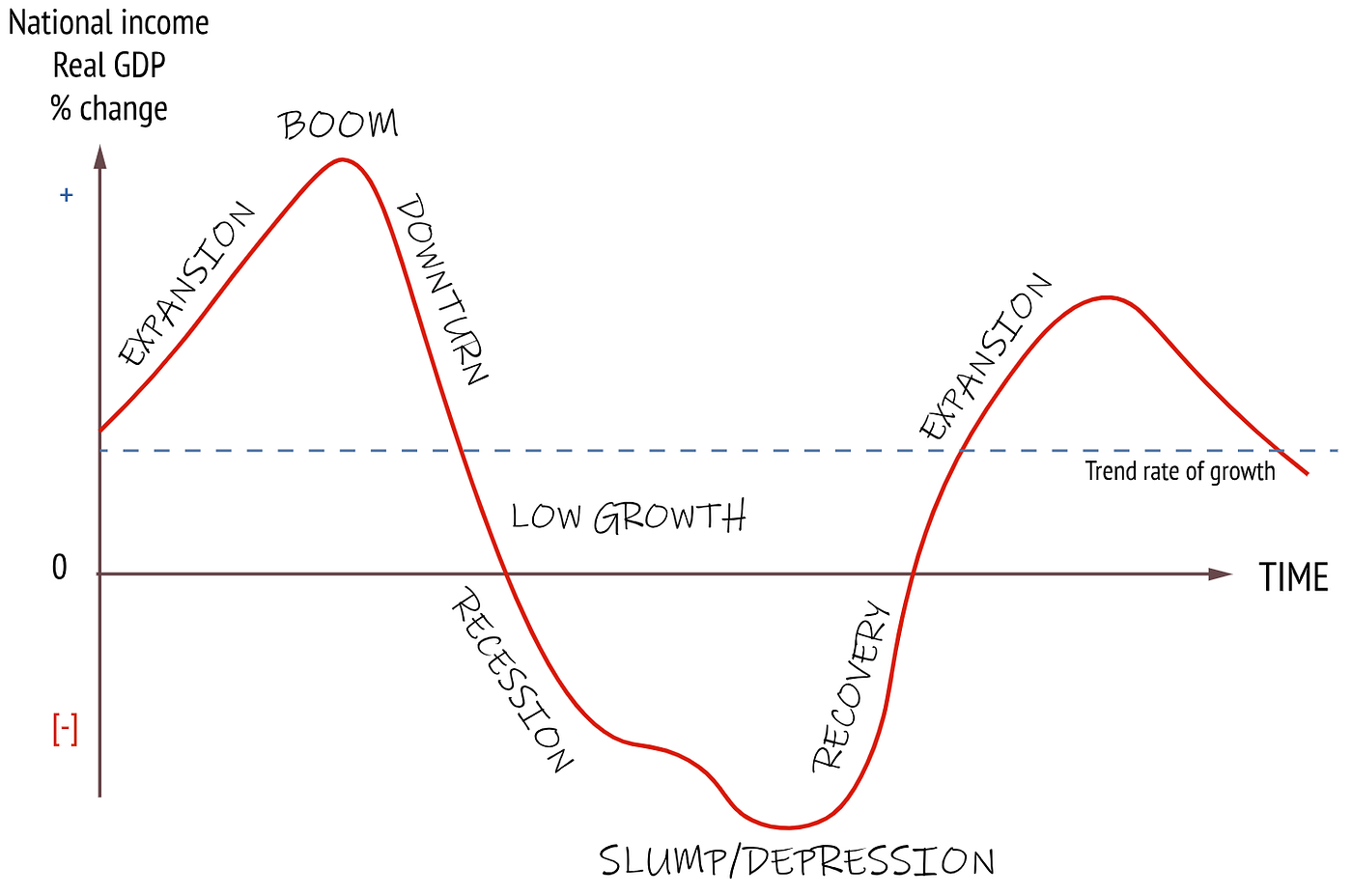
- These business cycles adversely impact poorer sections of societies. For example- During the recession, more population will experience poverty. It is the responsibility of the state to reduce the negative impact of these business cycles on weaker sections of society.
- 6) The private sector is not concerned about qualitative aspects of development. Economic growth is necessary but not sufficient. Social sector development is much more significant than economic growth.
- The private sector does not give importance to the interests of weaker sections of society. It is the responsibility of the state to protect and promote the interests of thes weaker sections through public policies.
- 7) Rural development is an area that is not given enough importance by the private sector as most of the development is concentrated in Urban areas. It is the responsibility of the state to develop rural areas by investing in both physical and social infrastructure.
- 8) Education and health are part of both the government and private sector but the problem is affordability. It is not possible for poor people to avail of quality services provided by the private sector.
- It is the responsibility of the state to make sure that the poorest sections of our society also have access to quality education and health.
- 9) Disaster management is not an activity that is performed by the private sector. It is the responsibility of the state to take care of victims of disaster management.
- Conclusion
- The private sector might ensure efficient utilization of resources, and NGOs and civil society organizations might ensure the participation of citizens in governance but it is only the state that can help in realizing the objectives of nation-building.
- The state can inculcate a sense of nationalism and patriotism in the minds of citizens and it can also make people sacrifice their self-interest for the sake of the country.
- To conclude, the question is not the quantity of state interference in the age of Liberalization and Globalization but the quality of it. Big government does not automatically mean better governance as pointed out by our PM, "In the age of Liberalization and Globalization, the government has no business to be in business".
- "Minimum Government and Maximum Governance" clearly describe the role of the state in the age of Globalization.
MULTI-ACTOR PARADIGM MODEL (03:53 PM)
- With the advent of liberalization, Privatization, and Globalization, the country is witnessing a multi-actor paradigm in governance
- Multiple institutions now are part of governance and all those institutions have their own vested interests.
-
Multi-actor paradigm in Governance Union Government, State government. Local self-government. Bureaucracy. Private sector. MNCs. Multilateral institutions. CSO, SHG, NGOs, and Pressure groups. Judiciary, Media. Religion, and cause-based organizations.
THE TOPIC FOR THE NEXT CLASS- MAX WEBER'S BUREAUCRATIC THEORY AND MULTI-ACTOR PARADIGM MODEL.